


Containerised software & orchestrators
Download
Landscape overview
The connectivity landscape is shifting rapidly. Over the last decade, the demand for a reliable and speedy network connection has grown exponentially, driven by an ever-increasing integration of connected applications and devices into our daily lives. According to Statistica, in 2023, the number of internet users globally grew to 5.4 billion – the highest it has ever been in 20 years of internet use. This surge in users reflects the growing need for a robust and dependable internet connectivity to facilitate growing communication, entertainment and access to information and data. But what exactly is behind and driving the shift ?
The rise of hybrid working
A notable moment in this development was the COVID-19 pandemic. This global event changed the course of history when it kicked off remote working, which inevitably led to an overflow of hybrid working as societies reopened.
In a post-COVID world, this demand for reliable home Wi-Fi has not waned. According to data from Statistica, as of 2022, 10.2% of those employed in the European Union reported to usually work from home . While this figure varies from country to country within the region, they largely reflect huge growth from the mid-noughties , indicating a
long-term, sustained shift in work culture and daily routines which demand a new era of connectivity.
With a significant number of Europeans now remote or hybrid working, the demand on connectivity services has increased exponentially.
Emerging technologies
Beyond the rise of remote and hybrid work models, the development of new technologies has emerged as another powerful driving force behind the surging demand for connectivity services. This can be demonstrated across several different facets.
The concept of ‘the smart home’ has been a huge turning point for connectivity and is predicted to show mammoth growth over the next five years. Data suggests that the smart home market will reach US$154.4bn in 2024, with an annual growth rate (CAGR) of 10.67% over the next four years, resulting in a projected market volume of US$231.6bn by 2028. Household penetration is also expected to grow from 18.9% in 2024 to hit 33.2% by 2028.
Another key area of growth is the number of connected game consoles in the home. With the rise of online gaming and cloud-based gaming services, users are increasingly requiring a stable and fast internet connection to enjoy seamless gameplay and access to online features. This trend is expected to continue with the development of even more immersive gaming experiences, such as virtual reality (VR) and augmented reality (AR). With day-to-day consumer habits evolving (including increased hybrid working and online gaming) alongside the development of new technologies (such as the growth of smart home devices), the average number of connected devices being supported by home Wi-Fi networks has inadvertently more than doubled in the next five years. According to data from Vodafone, the average number of connected devices in Europe now stands at 12 per household . As such, the need for a reliable and fast connection has never been more crucial.
Seeking alternative revenue
Despite significant growth in global internet usage, telco revenues are projected to plateau. To invest enough to support the future connectivity needs of industries and wider society, it’s imperative that telcos begin to identify and capitalise on new revenue streams. However, to achieve this, they may need to fundamentally alter the key products and services that they offer. Telco organisations may find success pursuing a variety of different avenues including the convergence of services, developing technologies and new products. However, given the changing nature of consumer requirements, it seems that the addition of value-added services is a route that many telcos should consider pursuing. Adding value-added services to Home Gateways unlocks a win-win situation for both consumers and internet service providers (ISPs). For users, these services can significantly enhance their home Wi-Fi and digital life experience, which is likely to translate to improved customer satisfaction. For ISPs, the benefits are equally compelling. In a competitive market where customer retention is paramount (currently sitting at 78% for the telecoms industry), even a slight increase in churn can have a significant impact. To make matters more concerning, an Accenture report 2020 suggests that 77% of consumers will retract their loyalty more quickly than they did three years ago.
Therefore, telcos must work harder than ever to retain their customer base. Offering value-added services is likely to become a powerful tool for improving customer retention rates, while allowing internet service providers to increase their average revenue per user (ARPU).As we move towards the future of connectivity, ISPs must look to alternative strategies to compete. Particularly in the era of the wholesale model where infrastructure is increasingly commoditised the addition of value-added services to Home
Gateways will be one of the crucial differentiators for ISPs.
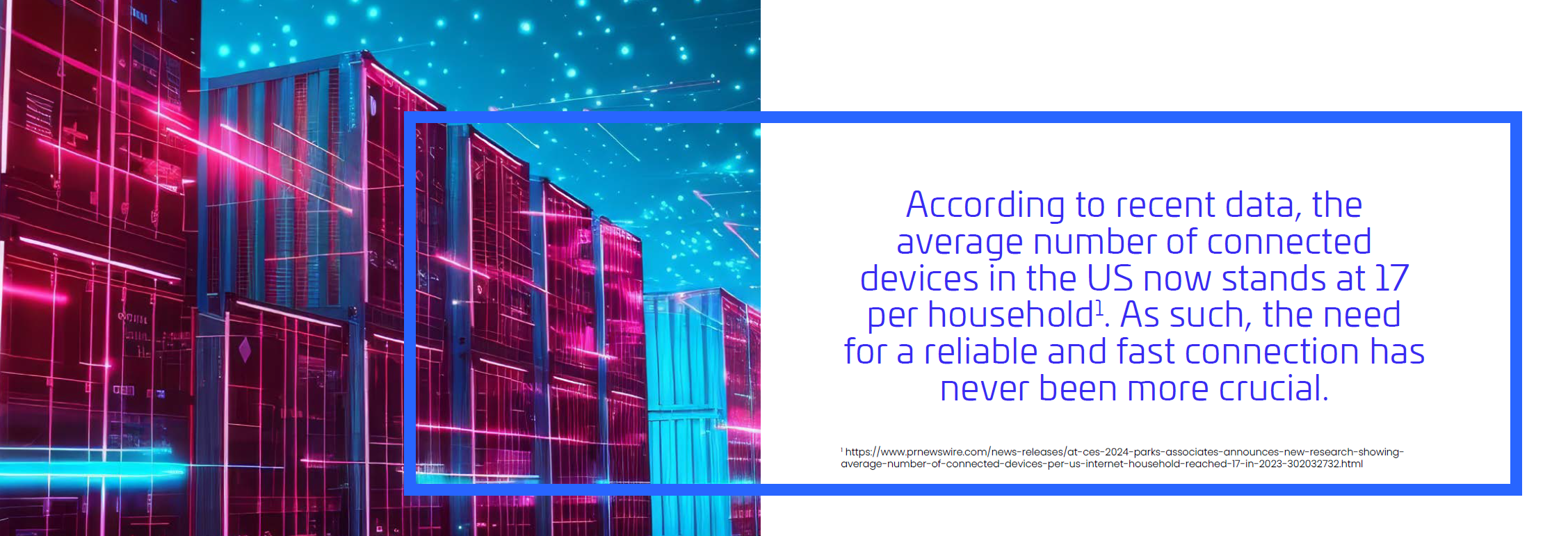
According to recent data, the average number of connected devices in the US now stands at 17 per household. As such, the need for a reliable and fast connection has never been more crucial.
https://www.prnewswire.com/news-releases/at-ces-2024-parks-associates-announces-new-research-showing-average-number-of-connected-devices-per-us-internet-household-reached-17-in-2023-302032732.html
Introducing containerised software and orchestration
While the introduction of extra value-added services to Home Gateways will offer telcos a tangible differentiator in a competitive market, it requires a shift away from traditional software approaches and the adoption of modern technologies like containerised software and orchestration systems.
The challenges of legacy systems
Previously, Home Gateways have relied on monolithic software. This type of software is a single, large codebase, making it difficult to modify or update specific functionalities. Adding new services often involved complex integration processes, lengthy testing cycles, and potential risks to existing functionalities. This rigidity hampered innovation and limited the ability of telcos to adapt to evolving customer needs.
The power of containerisation
Containerised software offers a revolutionary approach. It breaks down applications into smaller, self-contained units called containers. Each container includes its own user and dependencies, allowing it to run independently on any underlying infrastructure. This has several
advantages:
• Agility and speed: new services can be developed and deployed as individual containers, significantly accelerating development and deployment cycles. Updates become easier to manage, as modifications can be made to specific containers without impacting the entire system.
• Scalability: containerised applications can be easily scaled up or down based on user demand. This allows telcos to adjust their service offerings, catering to fluctuating user
requirements.
• Isolation and security: containers run in isolation, preventing them from interfering with each other or the core Home Gateway software. This enhances security by minimising the impact of potential vulnerabilities.
Orchestration takes centre stage
While containerisation empowers the creation and deployment of individual services, managing a multitude of containers within the Home Gateway requires an orchestration system. An orchestrator acts as a conductor, automating the deployment, management, and scaling of containerised applications. It ensures optimal resource allocation, monitors container health, and facilitates seamless communication between services.
Orchestration offers telco a multitude of benefits, including:
• Simplified management: orchestration automates complex tasks, freeing up IT resources to focus on strategic initiatives.
• Improved reliability: by constantly monitoring container health and managing resource allocation, orchestrators contribute to a more reliable and stable Home Gateway environment.
• Flexibility and customisation: orchestrators allow telcos to define deployment and scaling strategies tailored to their specific service offerings and network configurations.
• Automation: orchestrators allow telcos to automate services without human intervention.
As we move towards an increasingly digital-first world, the use of containerised software and orchestration systems will not only be technological advancements. But they will be considered essential tools to ensure telcos remain competitive and deliver the next generation of Home Gateway services. By embracing these technologies, telcos can unlock a future of agility, innovation, and value-added offerings, ultimately leading to a more differentiated and customer-centric approach to home connectivity.
Additional services and benefits
Boundless service opportunities – unlocking revenue and subscriber loyalty (additional services and benefits)
The Heights Telecom Orchestration System, powered by its own containerised software infrastructure, is more than a technical platform; it’s a strategic asset that opens a universe of service opportunities for CSPs, enhancing customer experiences and driving revenue growth. Imagine a network that anticipates and resolves issues before your subscribers even notice. With advanced Wi-Fi optimisation technologies, seamlessly integrated through the orchestration system, this proactive approach becomes a reality. By proactively optimising network performance and troubleshooting issues, you not only ensure a seamless user experience but also free up valuable resources for your teams, translating to significant cost savings and improved operational efficiency.
The smart home revolution is in full swing, and your network can be at the heart of it. By integrating SmartHome Matter services, through our orchestration system, you empower subscribers to effortlessly manage their connected lives from lighting and security to entertainment and energy management. Your network becomes the backbone of a truly intelligent home, solidifying your brand as a trusted provider of holistic digital solutions and opening new revenue streams. The future of service innovation lies in AI. The orchestration system is primed to usher in a new era of AI-powered services, personalised to each subscriber’s unique needs. Picture it, a network that dynamically adapts to individual usage patterns, optimising performance for every device and application. Delivering AI-driven cybersecurity that proactively safeguards your subscribers’ data, building trust and loyalty. These are just glimpses of the transformative potential that AI holds, and the orchestration system is your key to unlocking it. The orchestration system enables a wide range of additional value-added services, from advanced parental controls to seamless AI driven Cyber Security. These services not only enhance the customer experience but also create new revenue opportunities for CSPs. By bundling these services with existing offerings, you can increase your Average Revenue Per User, tapping into untapped revenue streams and bolstering your bottom line. Additionally, the improved customer experiences fostered by these value-added services lead to increased subscriber satisfaction and loyalty. A happy customer is a loyal customer, and by reducing churn and increasing retention rates, you can ensure a sustainable and profitable customer base for years to come. The Heights Telecom Orchestration System will transform your network into a dynamic platform for innovation, growth, and unparalleled customer experiences. It’s more than a technology; it’s a strategic investment in the future of your business, a future where you lead the charge in delivering the connected, intelligent services that subscribers demand. The orchestration system isn’t just about technology; it’s about unlocking new revenue streams, fostering deeper customer relationships, and securing your place as a leader in the ever evolving telecommunications landscape.
Product Spotlight
Heights Telecom’s Orchestration System – A Familiar Subscriber Experience
For service providers, the competitive landscape is constantly shifting. Today’s users juggle work, entertainment, and smart home devices, all the while demanding a personalised and seamless digital experience. The challenge is to not only meet those expectations, but also differentiate themselves in an increasingly competitive market.
In recognising this challenge, Heights Telecom offers a groundbreaking solution – our Orchestration System. This innovative platform, combined with our containerised
software offering, empowers service providers torevolutionise the subscriber experience while unlocking new revenue streams.Unlocking containterisation At the heart of our solution lies containerisation, a software deployment model that packages applications and their dependencies into isolated units called containers. This technology brings agility and flexibility to service deployment, similar to how smartphones revolutionised mobile applications.
Our containerised software, built on the Linux LXC container framework, allows service providers to effortlessly add and manage new services. Imagine a world where adding parental controls, cybersecurity features, or smart home integrations is as simple as downloading an app from the App Store, or Google Play. Our standardised protocols (DBUS, TR-181 data-model, TR-69, TR-369 and TR-157, USP) ensure seamless integration and a streamlined user experience.
Key benefits for service providers In addition to offering subscribers an enhanced experience through a curated marketplace of value-added services, service providers can also expect the following benefits from our containerised software:
• Increased ARPU: Generates additional revenue by introducing premium services like advanced QoS, cybersecurity, and smart home solutions.
• Reduced churn: Our software improves subscriber satisfaction through personalised experiences, and a diverse range of service offerings.
• Rapid time to market: Providers can deploy new services quickly and efficiently with our streamlined containerisation framework.
• Simplified management: Our orchestration system automates container deployment, activation, and lifecycle management, reducing operational overhead.
Customer centric solutions
Our orchestration system is designed to put the subscriber in control. By leveraging our ‘Workflow tools,’ service providers can create automated activation flows that seamlessly guide users through the installation and setup of new services. This self-service model empowers subscribers, enhances user experience, and reduces the burden on customer support. The future of telecom services Heights Telecom envisions a future where service providers offer personalised, on-demand services that adapt to the evolving needs of their subscribers. Our orchestration system, with its containerised software foundation, is the key to unlocking this future. It’s a future where service providers can differentiate themselves, increase revenue, and foster long-lasting relationships with their subscribers.
Devices are ‘onboarded’ onto a Matter network via BLE (Bluetooth) Matter devices connect via Wi-Fi or Thread Thread devices connect to IP networks via boarder routers (Heights Home Gateways)
Final thoughts
As technology continues to develop alongside the needs and priorities of the consumer, the telco market will see yet further evolution. It’s clear that personalisation will play an increasingly important role in connectivity, particularly in the functionality and user experience of Home Gateways.
Currently, Home Gateways are seen as the means to an end for providing connectivity. For many
consumers, there is no need to engage with it beyond ensuring a reliable and fast connection.
However, the integration of technologies such as orchestrators and containerised software will likely cause a shift in this consumer perception. The introduction of new and additional services will enable CSPs to offer customers a personalised approach to connectivity. These services will allow customers to pick and choose which features work for them. As a result, the role that connectivity plays in consumers’ day-to-day lives may shift considerably.
While some potential features (such as parental controls and cybersecurity measures,) are already well-known and understood by consumers, there are a number of lesser-known (but equally valuable) services that can be added to the Home Gateways. Advanced technologies including Wi-Fi sensing capabilities look set to change the reality of the connectivity landscape. Originally touted as a method for monitoring individual health, research suggests that Wi-Fi sensing may eventually be able to be used to monitor for falls in homes of the elderly , which would be a truly life-changing application.
The evolution of Home Gateways has the potential to redefine the relationship between
consumers and service providers, creating a more personalised, interactive and value-
driven ecosystem. The differentiator for telco organisations will be how they react and evolve in
this changing industry environment.
Moving forward, it’s clear that telco organisations will need to re-evaluate their proposition in order to compete within a fierce market. By leveraging containerised software and orchestration systems, telcos will be able to harness the full potential of value-added services. This strategic shift will not only differentiate them in a crowded market, but also ensure they are well-equipped to meet the ever-growing demands of a digital future.
For telco organisations, this future goes beyond simply offering internet access. By embracing these technologies, telcos can transform Home Gateways into intelligent hubs, capable of delivering a personalised and secure connected experience for each user. This agility will allow
telcos to not only stay ahead of the curve, but also redefine their role in the digital landscape, evolving from mere connectivity providers to trusted partners for a truly connected future.
For more information about Heights Telecom’s Orchestration System or containerised software
model, please visit www.heights-t.com

.png)

Favon 43 CH 1204
Genève
Israel
UK LTD.
USA INC.